Abstract
Credit is priced by the cost of understanding the borrower. For small and unusual businesses, that cost is higher than the loan is worth, so most of them are never served. Agents collapse that cost. Antal builds frontier models that research a business, match it to capital, and shape repayment to how it is paid, and a lending business that trains those models with every loan. The first product is a credit card held by the company's agent.
The loan nobody underwrites
About 1.4 billion adults still have no account at a bank or a mobile money provider. Small businesses in developing economies face a financing gap estimated in the trillions of dollars. The usual explanation is risk. We think the usual explanation is wrong.
A loan is priced by what it costs to understand the borrower. A $3,000 loan to a fisherman takes the same analyst, the same calls, and the same file as a $300,000 loan to a company with audited books. On the small loan, that work eats the margin. On the unusual one, there is no model to lean on. So the loan is never declined. It is never priced.
The market that results is not small. It is the part of the world that lending skipped because reading it was too expensive.
Underwriting is research
Every unique business case is a research problem: what the business does, who pays it, when, and what could stop the money. People do this research well, slowly, and at a cost. They also get tired of edge cases, and edge cases are most of the world.
Agents do the same research in parallel and in minutes. They read everything, they ask the follow-up question, and the hundredth strange business gets the same attention as the first. The cost of understanding a borrower falls toward zero. When it does, the loans that never made economic sense start to.
Our frontier models
Antal is developing frontier models for credit. They are not a score with a chat window on top. They answer three questions a lender has always had to answer by hand, for businesses no rate sheet was written for.
- 01
Research
What is this business, really?Deep research on a company from the work itself: what it sells, who pays it, how often, and what the season does to the cash. The conversations an owner chooses to connect are part of the record.
- 02
Match
Who should lend, and how much?Finds the right capital for a case no rate sheet was written for, and sets a limit the business can carry instead of a limit the form allows.
- 03
Repay
How does the money come back?Shapes repayment to how the business is actually paid. A fisherman paid weekly repays weekly. A shop paid at the register repays from the register.
The models learn from our own lending book. Every line we extend, every payment, and every miss goes back into the next decision. That is why we lend and build models in the same company: the book is the training data, and the models are how the book grows.

Why give a card to an agent
The agent is already where the company's work happens. It writes the code, answers the customers, books the jobs, and buys the tools. It sees the business more clearly than any form an owner fills in once a year.
It can also be bounded in ways a person can't. A card held by an agent has a limit the agent cannot raise, a number the agent never sees in full, and an owner who confirms anything that changes the company. The card is the first credit product an agent can hold safely. It won't be the last.
Trust you can underwrite
Limits grow the way trust grows: with evidence. Each layer below is something we can verify, price, and insure.
- 01
The work
Connected conversations and the company's activity set the first limit.
- 02
A certified agent
We certify and insure the agent that runs the card, so the agent itself becomes underwritable.
- 03
Personal Guarantee Insurance
Insuring the owner's guarantee unlocks a line of credit above $100,000.
Agent-to-agent lending
Today a borrower fills in a form and a person reads it. Tomorrow the company's agent asks, and Antal's agent underwrites, prices, and services the line. The question and the answer move at the speed of the work.
Lending stops being a desk. It becomes a conversation between two agents, with a person confirming the decisions that matter.
One flywheel
Better models find borrowers no one else can price. Those loans grow the book. The book's outcomes train the models. Each repaid loan makes the next decision cheaper and more accurate, and each new kind of business teaches the models something no competitor has seen.
Roadmap
Stage one
The agent card
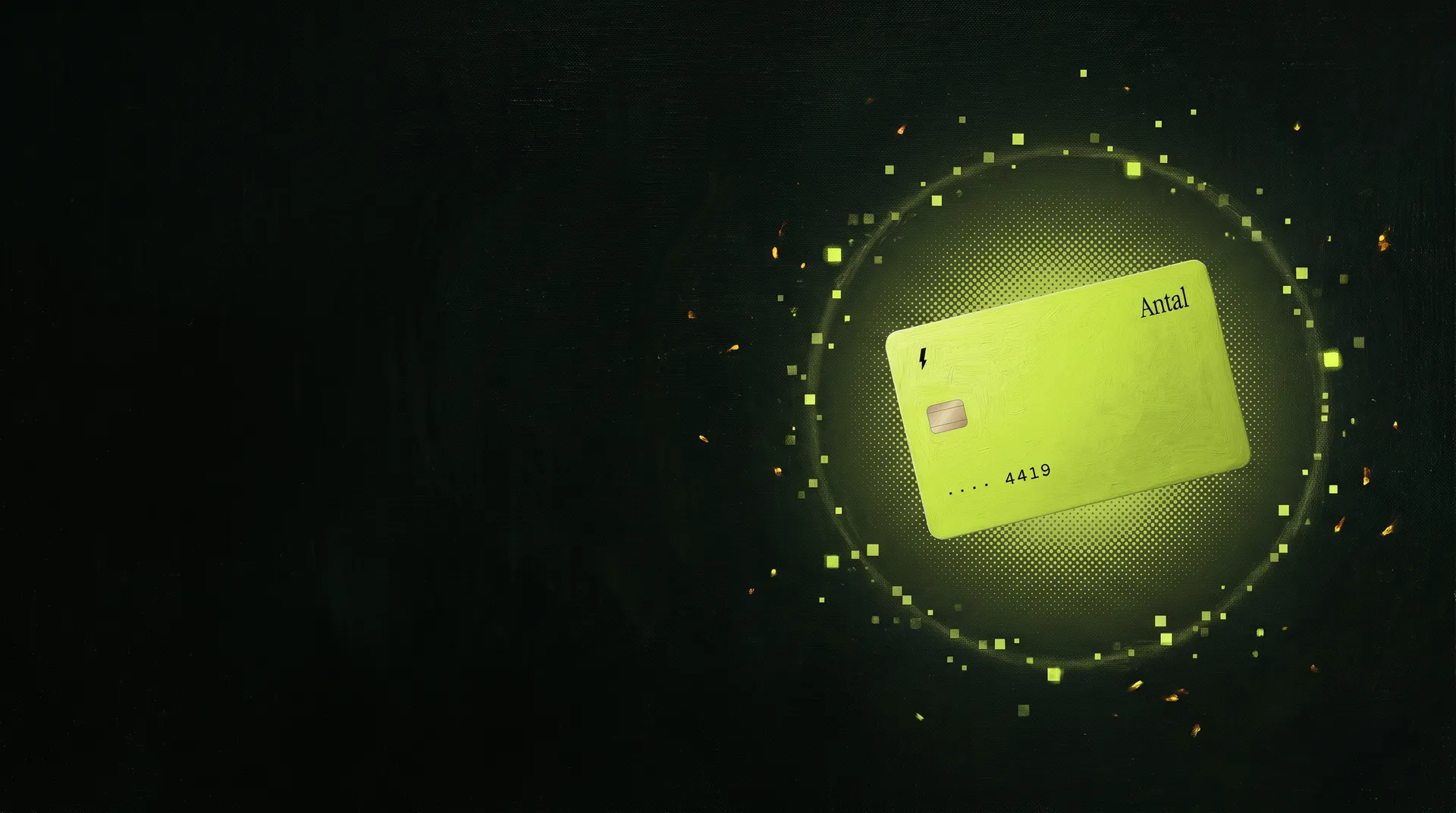
The first AI agent credit card. Only the agent manages it. The limit comes from the work.
Stage two
Lines on what the company owns
Credit against property, equipment, and revenue, underwritten by the same models.
Stage three
The loans no desk would take
Small, unusual businesses anywhere, underwritten and serviced agent to agent.
What could go wrong
Credit at machine speed fails at machine speed too. We design for that from the start.
- Fraud
- An agent can fabricate a story faster than a person can. Every limit is tied to evidence we can verify, not to what an agent claims.
- Misuse
- The agent never sees the full card number, and anything that changes the company comes back to a person as a confirmation link.
- Bad models
- Limits start small and grow with repayment, so a wrong answer costs little and teaches the model something.
- Regulation
- Credit is regulated for good reasons. We work inside those rules and with licensed partners where they require it.
Conclusion
The next billion borrowers will not walk into a branch. Their agents will ask for them. The lender that can read a fisherman's business in minutes, and get repaid on his schedule, gets on the ride. Everyone else stays on the dock.
The first AI agent credit card is where it starts.
Get a cardReferences
- World Bank, The Global Findex Database 2021.
- SME Finance Forum and IFC, MSME Finance Gap (2017).
- Fabric Ventures, The Emergence of the Machine Economy (2026).
The fisherman is an illustrative example. This paper describes where Antal is going, not a current offer of credit in any market.